

Payment Links
MoneyHash Payment Links are hosted, branded checkout pages tied to a specific customer and a list of items. You generate a unique URL via the API (or dashboard), share it, and the customer completes payment - no frontend required.
Each link automatically applies your account's brand settings (logo, name, colors) and incorporates any configured taxes into the final amount. The link is scoped to a single MoneyHash customer, so only that customer can complete the purchase.
Branding: Payment links inherit your account's logo, brand name, and colors automatically - no extra configuration needed.
Dashboard: You can also create and manage payment links directly in the MoneyHash dashboard without writing any code.
When to use
Payment links are the right tool when you need to collect payment without building a checkout flow yourself.
| Use case | Why payment links fit |
|---|---|
| Selling products or services without a website | No frontend required - the hosted page handles everything |
| Invoicing individual customers | Link is customer-scoped; only the intended recipient can pay |
| Collecting donations | Adjustable quantity lets customers choose their amount |
| Subscription or one-time payments via messaging | Share the URL over email, WhatsApp, or social media |
| Prototyping a checkout flow | No integration code needed for early validation |
How to create a payment link via API
Step 1 - Authenticate
All requests require your API key passed in the X-Api-Key header, or an access_token as a query parameter.
See the Programmatic Access page for how to generate sandbox and live API keys and attach them to your requests.
Step 2 - Create or retrieve a customer
Payment links are scoped to a specific customer. Create one via POST /api/v1.1/customers/ and note the returned UUID. If the customer already exists, retrieve their UUID from the dashboard or the List Customers endpoint.
See the Customers API page for a complete request/response example.
Step 3 - Call the Create Payment Link endpoint
Send a POST request to /api/v1.4/payment_links/ with the customer UUID, a list of items, currency, and quantity_type.
Request
{
  "customer": "5f9e2c1a-8b3d-4e6f-9a2b-1c3d4e5f6a7b",
  "name": "Invoice #1042",
  "description": "Consulting services — June 2026",
  "currency": "USD",
  "quantity_type": "FIXED",
  "items": [
    {
      "name": "Consulting hours",
      "unit_price": "150.00",
      "quantity": 4
    },
    {
      "name": "Setup fee",
      "unit_price": "50.00",
      "quantity": 1
    }
  ]
}
Step 4 - Retrieve the URL from the response
The response body contains a url field - this is the shareable payment link. The initial status is PENDING.
Step 5 - Share the link
Copy the URL and distribute it via email, SMS, WhatsApp, or any other channel. The customer does not need a MoneyHash account.
Step 6 - Monitor status
Pull GET /api/v1.4/payment_links/{payment_link_id}/status/ or listen for webhooks to track the link from PENDING → PAID (or EXPIRED).
Response
{
  "status": {
    "code": 200,
    "message": "success",
    "errors": []
  },
  "data": {
    "id": "wA9eY9m",
    "status": "PAID",
    "url": "https://pay.moneyhash.io/wA9eY9m",
    "customer": "5f9e2c1a-8b3d-4e6f-9a2b-1c3d4e5f6a7b",
    "currency": "USD",
    "amount": "650.00",
    "paid_at": "2026-07-10T14:32:07+00:00"
  }
}
Quantity types
The quantity_type parameter controls whether customers can change item quantities at checkout.
| Value | Behavior |
|---|---|
FIXED | Quantities are locked. Customers pay exactly the amounts you set. |
ADJUSTABLE | Customers choose quantity per item, up to a maximum of 99. |
Setting up taxes
Taxes are applied automatically based on your account settings. To configure them:
- Go to Settings → Accounts in the MoneyHash dashboard.
- Select the account you want to update.
- Set Tax Number (fixed amount) and/or Taxes (percentage rate).
Payment link lifecycle
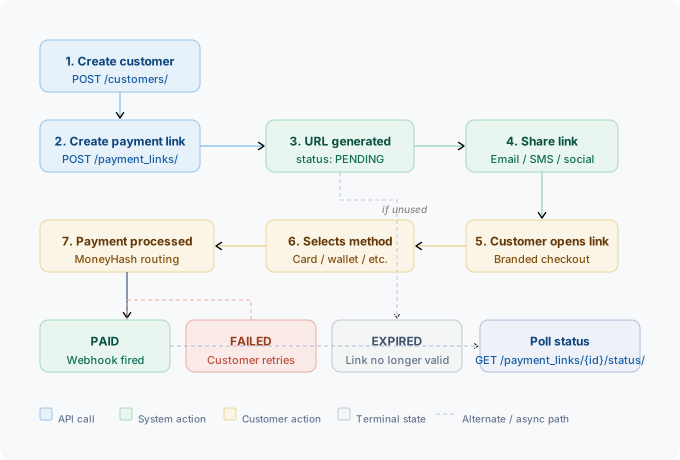
Common errors & troubleshooting
| Status | Error | Likely cause | Fix |
|---|---|---|---|
400 | Invalid Customer Token | The customer UUID does not exist in your account. | Create the customer first via POST /api/v1.4/customers/ and use the returned UUID. |
400 | This field is required | A required field (name, description, currency, items, or quantity_type) was omitted. | Check the request body and ensure all required fields are present. |
400 | Invalid items format | items is not a valid array, or an item is missing name, unit_price, or quantity. | Ensure each item object has all three fields. unit_price must be a decimal string, e.g. "10.00". |
401 | Authentication credentials were not provided | The X-Api-Key header or access_token query param is missing. | Add X-Api-Key: YOUR_KEY to every request. |
401 | Invalid API key | The key format is correct but does not match any active key on this account. | Verify the key in the MoneyHash dashboard. Use sandbox keys for test mode, live keys for production. |
404 | Not found | The payment_link_id in the URL does not exist or belongs to a different account. | Double-check the ID returned at creation. IDs are case-sensitive (wA9eY9m ≠ wa9ey9m). |
Debugging checklist
- Confirm you are using the correct environment - sandbox API keys will not work against the production base URL and vice versa.
- Check
status.errorsin the response body - it often contains field-level validation details. - Ensure
unit_priceis sent as a string with up to 2 decimal places (e.g."10.00"), not a raw number. - If tax amounts look wrong, review your Tax Number and Taxes settings under Settings → Accounts.
- If the customer cannot open the link, confirm the link's
statusis stillPENDING- expired links return no payment UI.
Still stuck? Reach out via the MoneyHash dashboard support widget or email your account team with the full response body including
status.errors.
Updated 2 months ago